
I was so inspired by the Keynote Speakers at the EdTechRVA Conference, I had to write a separate post about their work at Hungary Creek Middle School in Henrico, VA.
The keynote session by teacher Jason Vest and principal Robbi Moose was entitled “Explore – Collaborate – Create: Making #LifeReady Learners at The Creek”. They had one heck of an inspiring keynote describing the way they are doing things at their school.
For the last 10 years the school leadership has led with this idea of the “Knowing and Doing Gap”, a theory developed by Jeffrey Pfeffer and Robert I. Sutton, the authors of The Knowing-Doing Gap: How Smart Companies Turn Knowledge into Action.
One of the most important insights from our research is that knowledge that is actually implemented is much more likely to be acquired from learning by doing than from learning by reading, listening, or even thinking” (Pfeffer and Sutton, p. 6).
My biggest takeaway from this part of their presentation was the understanding that knowing that change is needed is not enough. There has to be action and implementation, however many people will make excuses, fear change, and have general distrust about the process. Take school reform for example. Some schools fail if there isn’t something done to also recreate the culture. They asked the audience if this sounded familiar and for me it did. I’ve been in 5 schools in my career and have seen many variations of this. But overall, I think the reason it resonated with me so much is that I’m in a season of continuing to improve my skills and this idea of “knowing” versus “doing” could have a big impact on me; keeping me on track when I struggle with something new or hit a roadblock.
At Hungary Creek, they knew that student engagement needed to be at the forefront of what they do. But when they considered this, they also realized that their teachers had to change and they shifted their staff professional development towards training in growth mindset, something I am becoming a huge fan of. Seriously, if you haven’t read George Couros’ book, “The Innovator’s Mindset”, you need to go read it! This was a big game changer for me when I read it last summer.
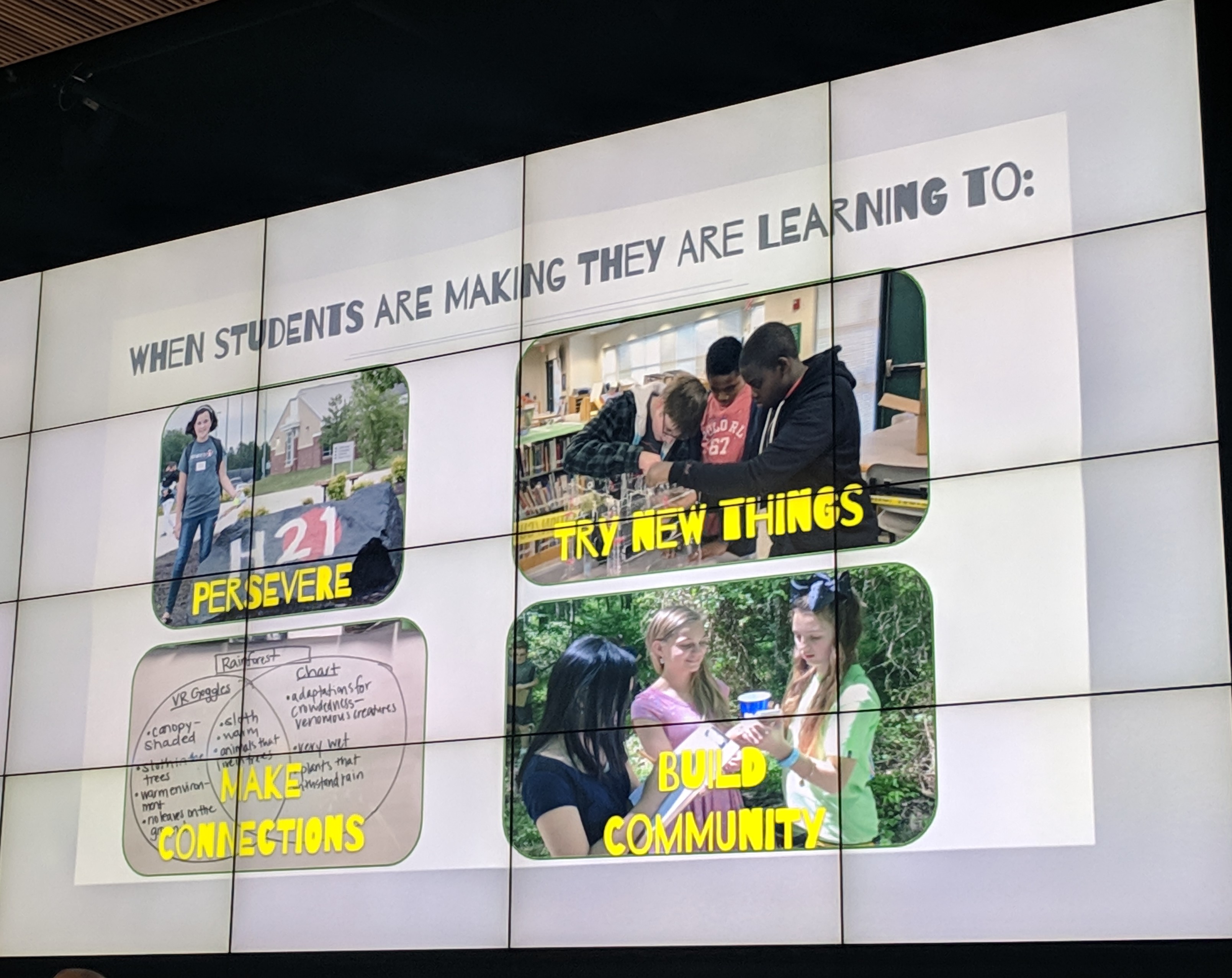
In training their staff this way, their school ended up shifting towards a Project-Based Learning (PBL) and Maker culture. Some of their results include: an ELA class project where students read “The Giver” and then took portions of the book to create a virtual reality (VR) tour; in another class, they made sure to play towards students’ passions, allowing them to decide on their own proposals and then use a 3D printer to make prototypes. When it printed out, if it didn’t end up being what they imagined, they learned to adapt their prototypes and problem solve until they got it right.
Students have also been creating videos with green screen. In P.E. classes they showed the 5 components of fitness and in Science crucial lab safety tips. They’ve also used Legos to show how plate tectonics work using Stop Motion Animation.
But here’s the biggest change. Instead of students completing a project and turning it in for the teacher to grade, students present their project to a group of people. This group includes administrators from other schools, community leaders, business owners, school board members and others. This group evaluates and grades the projects, giving students feedback. When the students were surveyed about how they wanted to be graded, traditional versus this new approach, 80% of students wanted the new approach claiming “they learned more.” Lessons became purposeful and students worked harder because lessons had meaning.
I appreciated that Moose and Vest also talked about how this hasn’t always been an easy venture relating it to a “Messy Grind”. Their biggest issue with this of way of teaching was that teachers felt like they didn’t have time to explore innovative tools and still teach content. So the school leaders adapted once again to change their schedule. The end of every school day has 30 minutes built in for teachers to work with students to play, innovate, and try new things. No new content can be taught during this time as it truly a time to explore and investigate. From the results they showed, it’s working!
They’re now adapting one more time. For those outside of Virginia, our state is redefining the Profile of a Graduate, the requirements and skills high school students need in order to graduate. The state is slowly moving away from standardized testing and working to incorporate more skill and project-based components for students. In Henrico County, they have decided to go beyond this requirement for high school students and created a learner profile for their entire district, K-12.

In a later session entitled “Making Innovators” with their school’s Innovation Learning Coach, Mike Dunavant, I would learn that the inside of this chart describes “the what” with characteristics of the 5C’s; Communication, Collaboration, Critical Thinking, Creativity, and Citizenship. They’ve added a 6th C with Character. The outside of the chart is “the how” with the 4 Pillars from the Deeper Learning Model. They’ve pushed the focus to be on what students are doing.
I was thoroughly floored by all that they had to present and would really like to see more! The whole idea of having students present their work to people other than their teachers or class mates really intrigued me. One of the things my high school is trying to build now is creating relationships with local business to make sure our students are learning skills that upon graduation can land them a job with their company. I could easily see us incorporating a similar model to Hungary Creek and ask business owners to be on a panel to listen to student presentations. I think it would certainly change some mindsets.
 Ms Priester EDU
1 thought on “EdTechRVA Conference: Keynote”